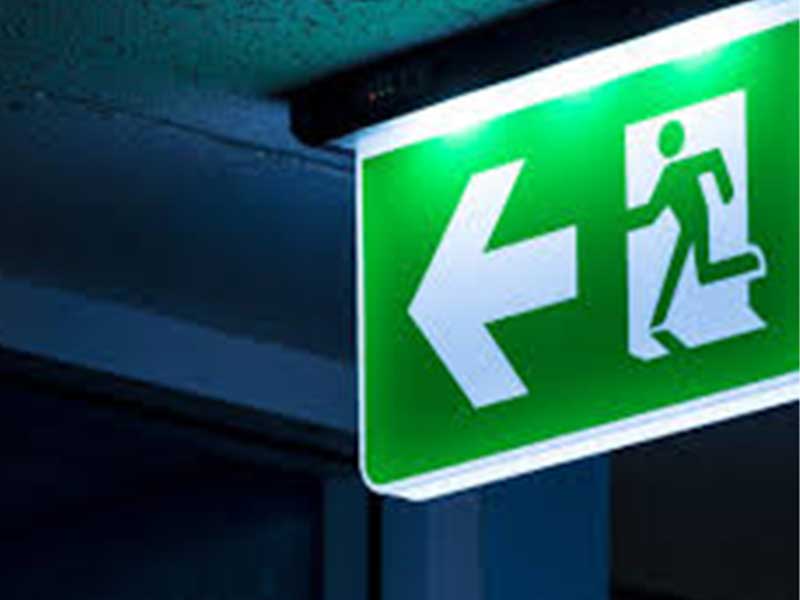
EMERGENCY & EXIT LIGHT SYSTEM
Emergency lighting is a vital and effective life safety tool, providing reassurance and guidance to people at critical times when they need to escape quickly and safely from a building. Specific requirements for emergency lighting are set out in law, and international standards. This design guide will help you to plan and implement an emergency lighting installation, that satisfies all the legal requirements, and ensures safe evacuation in the event of an emergency
An emergency light is a battery-backed lighting device that switches on automatically when a building experiences a power outage. Emergency lights are standard in new commercial and high occupancy residential buildings, such as college dormitories, apartments, and hotels.
STARCO designs the layout from the building’s escape strategy — covering escape routes, changes of direction and level, stairs, final exits, fire fighting equipment points and call points — then supplies, installs, tests and certifies the installation, and maintains it under the same preventive maintenance contract as the fire alarm system.
TYPES OF EMERGENCY LIGHTING SYSTEM
- SELF CONTAINED SYSTEM
- CENTRAL MONITORED SYSTEM
- CENTRAL BATTERY SYSTEM
SELF CONTAINED SYSTEM
Each luminaire carries its own battery, charger and control gear, so every fitting is an independent emergency light. Losing the local supply to one fitting affects only that fitting, and there is no fire-rated sub-main to run, which keeps installation cost and disruption down. It is the usual choice for offices, retail units, villas and smaller commercial buildings.
The trade-off is maintenance: every battery is in a different place, so testing and replacement is a walk of the whole building unless the fittings are self-testing.
CENTRAL MONITORED SYSTEM
Self-contained luminaires with addressable monitoring, reporting to a central panel over a dedicated loop. The panel runs the required function and duration tests automatically and logs the result for every fitting, so a failed lamp or a battery at the end of its life is identified by address rather than found on a walk round.
This is what large and multi-tenant buildings tend to need — hotels, hospitals, malls, schools and towers — both because manual testing at that scale is impractical and because the printed log satisfies inspection with no argument.
CENTRAL BATTERY SYSTEM
One battery bank in a protected plant room supplies every emergency fitting in the building over fire-rated cabling. The luminaires themselves hold no battery or charger, which makes them simpler, longer-lived and suitable for high ambient temperatures where local batteries degrade quickly.
All maintenance is in one place, and the battery can be sized for longer durations than a local cell will give. It needs fire-rated distribution and a dedicated room, so it is normally specified at design stage for large or high-risk buildings rather than added later.
EXIT SIGNAGE AND TESTING
Illuminated exit and directional signage is designed and installed as part of the same system, in maintained or non-maintained form according to the occupancy. Installations are commissioned with a full function and duration test, and tested at the intervals required by Abu Dhabi Civil Defence thereafter, with a certificate issued on completion.