CLEAN AGENT SYSTEM
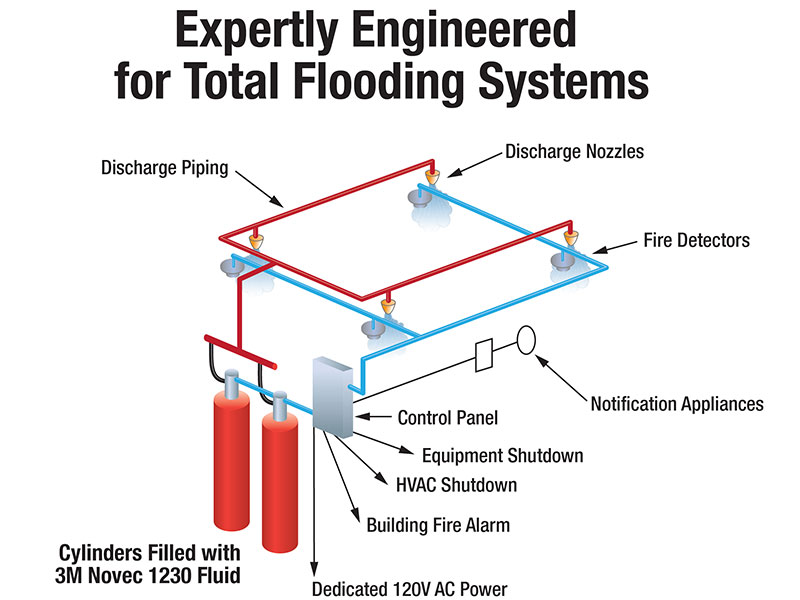
NFPA 2001 defines a clean agent as an electrically non-conductive, volatile or gaseous fire extinguishing agent that does not leave a residue upon evaporation. A clean agent fire suppression system stores either an inert gas or a chemical agent in cylinders and discharges it, when called on, to extinguish a fire while it is still in its incipient stage.
These systems are fast, safe, clean and three-dimensional — most reach extinguishing concentration in ten seconds or less, and there is no costly clean-up afterwards because the agent vaporises and dissipates without leaving a residue. That makes them the right answer wherever water or powder would destroy what the system is there to protect: server and comms rooms, switchrooms and substations, control rooms, medical imaging suites, archives, museums and laboratories.
STARCO designs the system to the volume and construction of the enclosure, sizes and sites the cylinder bank, runs the discharge pipework and nozzles, integrates detection and the release panel with the building fire alarm system, and carries out the room integrity and discharge testing needed for Civil Defence approval.
CLEAN AGENTS SUPPLIED
- FM-200 GAS (HFC-227ea)
- NOVEC 1230 GAS
- IG-541 GAS
FM-200 GAS (HFC-227ea)
The most widely installed chemical clean agent, stored as a liquefied gas under nitrogen pressure and discharged as a colourless, odourless vapour. It extinguishes principally by absorbing heat from the flame, and reaches extinguishing concentration within ten seconds.
Because it is stored as a liquid, an FM-200 system needs relatively little cylinder space for the volume it protects, which suits retrofits and rooms where there is no room for a large bank. It is electrically non-conductive, leaves no residue, and is approved for use in normally occupied spaces at design concentration.
STARCO supplies FM-200 factory-filled to the calculated charge for the enclosure, and refills existing systems after discharge or test.
NOVEC 1230 GAS
A fluoroketone agent that is a liquid at room temperature and vaporises on discharge. It suppresses fire by heat absorption in the same way as FM-200 and shares the ten-second discharge, the residue-free behaviour and the electrical non-conductivity.
What separates it is its environmental profile: zero ozone depletion potential, a global warming potential of about one, and an atmospheric lifetime measured in days rather than years. It also carries the widest margin between design concentration and the level at which it affects people, which is why it is often specified for occupied spaces and for projects with sustainability requirements attached.
IG-541 GAS
An inert gas blend of nitrogen, argon and carbon dioxide — naturally occurring gases, stored as a high-pressure gas rather than a liquid. It works by displacement rather than heat absorption, lowering the oxygen in the enclosure below the level that sustains combustion while keeping it high enough for a person to breathe and evacuate.
Because nothing condenses on discharge there is no fog and no thermal shock to electronics, and because the agent is a gas the cylinder bank can be sited remotely and piped to the risk — useful where the protected room has no space to spare. The trade-off is cylinder count: an inert system needs more storage than a chemical agent for the same volume.
ALSO SUPPLIED
Carbon dioxide total-flooding and local-application systems are supplied for normally unoccupied risks where a non-clean agent is acceptable. All gaseous systems — CO2, FM-200, INERGEN and Argon — are covered by STARCO’s preventive maintenance package.