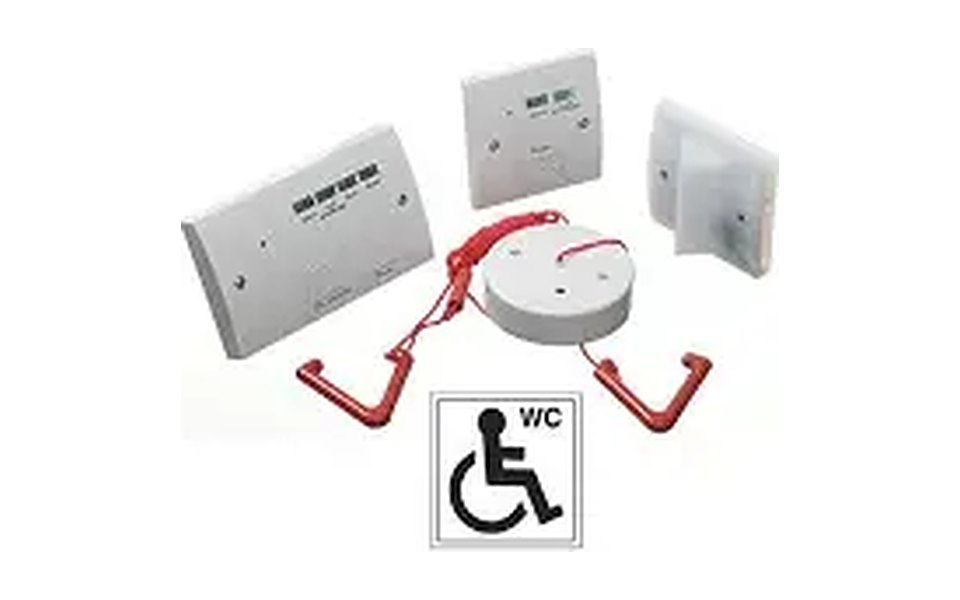
DISABLED TOILET ALARM SYSTEM
An accessible WC is the one room in a building where a person may be alone, unable to stand, and behind a locked door. A disabled toilet alarm — DTA — is the system that gets them help: a pull cord they can reach from the floor, a light and sounder outside the door that says which cubicle, and an indication at a point where somebody is on duty.
The detail that makes the difference is the reassurance indicator inside the cubicle. Without it the person who pulled the cord has no way of knowing whether anything happened. STARCO installs the system so that the call is acknowledged in the room, announced outside it, and repeated to staff, and so that it can only be reset from inside the cubicle — never silenced from the corridor by someone who has not checked.
Disabled toilet alarms are installed in offices, malls, schools, mosques, hospitals and clinics, hotels, and public and government buildings, and appear in the scope of a large number of STARCO’s projects alongside the fire alarm and emergency lighting package.
COMPONENTS OF THE SYSTEM
- CEILING PULL CORD UNIT
- REASSURANCE INDICATOR AND RESET
- OVER-DOOR INDICATOR
- REMOTE INDICATOR PANEL
CEILING PULL CORD UNIT
A ceiling-mounted unit with a cord long enough to be reached from the floor, fitted with two bangles so it can be found and pulled by someone who has fallen. The cord is run clear of the door swing and of the WC itself, so it stays reachable from the positions a person is actually likely to be in.
REASSURANCE INDICATOR AND RESET
A unit inside the cubicle that lights and sounds to confirm the call has been placed and is being answered. It carries the reset button, so the alarm can only be cleared by someone who has entered the room — which is the whole point of the system.
OVER-DOOR INDICATOR
A combined sounder and beacon above the cubicle door, so anyone passing can see immediately which room the call came from. Where several accessible WCs sit together, each has its own indicator and its own address.
REMOTE INDICATOR PANEL
A panel at reception, the security desk or the nurses’ station repeating the call by location, so the alarm reaches staff rather than relying on someone happening to walk past. In larger buildings the units are networked back to a central controller covering every accessible WC on the site.
INSTALLATION AND MAINTENANCE
Systems are supplied with battery-backed power so a call can still be placed with the mains off, commissioned by testing every cord, indicator and remote panel, and covered by STARCO’s preventive maintenance contract alongside the fire alarm and emergency lighting systems.