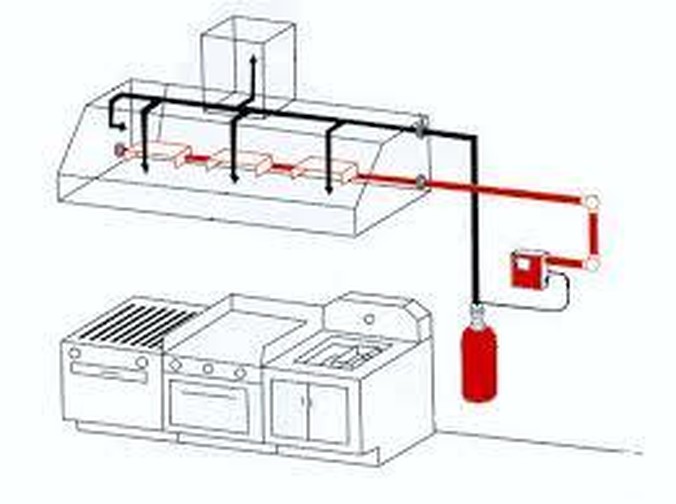
WET CHEMICAL SYSTEM
A commercial kitchen is the one fire risk in most buildings that ordinary suppression cannot handle. Cooking oil burns far above the temperature at which water flashes to steam, and it re-ignites from its own residual heat once a flame is knocked down. A wet chemical system is designed for exactly that: a potassium-salt solution discharged as a fine mist over the appliance, which reacts with the hot oil to form a soapy blanket — saponification — sealing the surface from air while the water content cools the oil below its auto-ignition temperature.
The system protects the whole cooking line as one risk: the appliance surfaces, the hood plenum and the extract duct, where grease deposits carry fire away from the kitchen and into the building.
It is specified for restaurant, hotel, school, hospital, labour accommodation and staff canteen kitchens, and is a Civil Defence requirement for commercial cooking operations in Abu Dhabi.
COMPONENTS OF THE SYSTEM
- AGENT TANK AND RELEASE MODULE
- DETECTION LINE AND MANUAL PULL STATION
- DISCHARGE NOZZLES AND DISTRIBUTION PIPING
- APPLIANCE FUEL AND POWER SHUT-OFF
AGENT TANK AND RELEASE MODULE
Stainless steel agent tanks sized to the number and type of appliances, held in a cabinet beside the hood with a gas cartridge that expels the charge on release. The mechanical release module needs no electrical supply to operate, so the system works with the power off.
DETECTION LINE AND MANUAL PULL STATION
Fusible link detectors sit in the hood directly above each appliance, on a tensioned cable running back to the release module. Heat parts a link, the cable releases, and the system fires. A manual pull station on the escape route from the kitchen lets staff discharge the system by hand at any time, and is the required means of manual operation.
DISCHARGE NOZZLES AND DISTRIBUTION PIPING
Each appliance type — fryer, range, griddle, wok, char-broiler, salamander — has its own nozzle type, position and coverage, and the plenum and duct are nozzled separately. The nozzle schedule is calculated for the actual kitchen layout, which is why the system has to be redesigned whenever appliances are moved or replaced.
APPLIANCE FUEL AND POWER SHUT-OFF
Discharge simultaneously shuts off gas and electrical supply to the appliances through a mechanical gas valve or shunt trip, so the heat source is removed at the same moment the agent lands. Without this interlock a fryer will simply re-heat the oil and start again. The system can also signal the building fire alarm panel.
MAINTENANCE AND RECHARGE
Wet chemical systems are inspected and tested under STARCO’s preventive maintenance contract at the intervals required by the manufacturer and Civil Defence — fusible links replaced on schedule, nozzle caps and coverage checked against the current appliance layout, and the system recharged after any discharge.